You paid for a royalty-free track, added the required credit, and still got a YouTube Content ID claim. Or you finished a two-hour Twitch stream only to discover that parts of the VOD were muted because of the background audio.
The confusing part is that you may not have done anything wrong. "Royalty-free," "copyright-free," and "AI-generated" describe how a track is licensed or created—not necessarily how YouTube, Twitch, or automated DRM systems will identify and handle it.
That distinction is where most of the confusion starts.
Why does royalty-free music still get Content ID claims?
The short answer: a license to use music and an automated platform's ability to recognize music are two different things.
YouTube's Content ID system doesn't know that you personally purchased a license. It analyzes uploaded videos and compares audio against reference files submitted by rights holders or music distributors.
If your video contains a track that matches one of those references, the system can generate a claim.
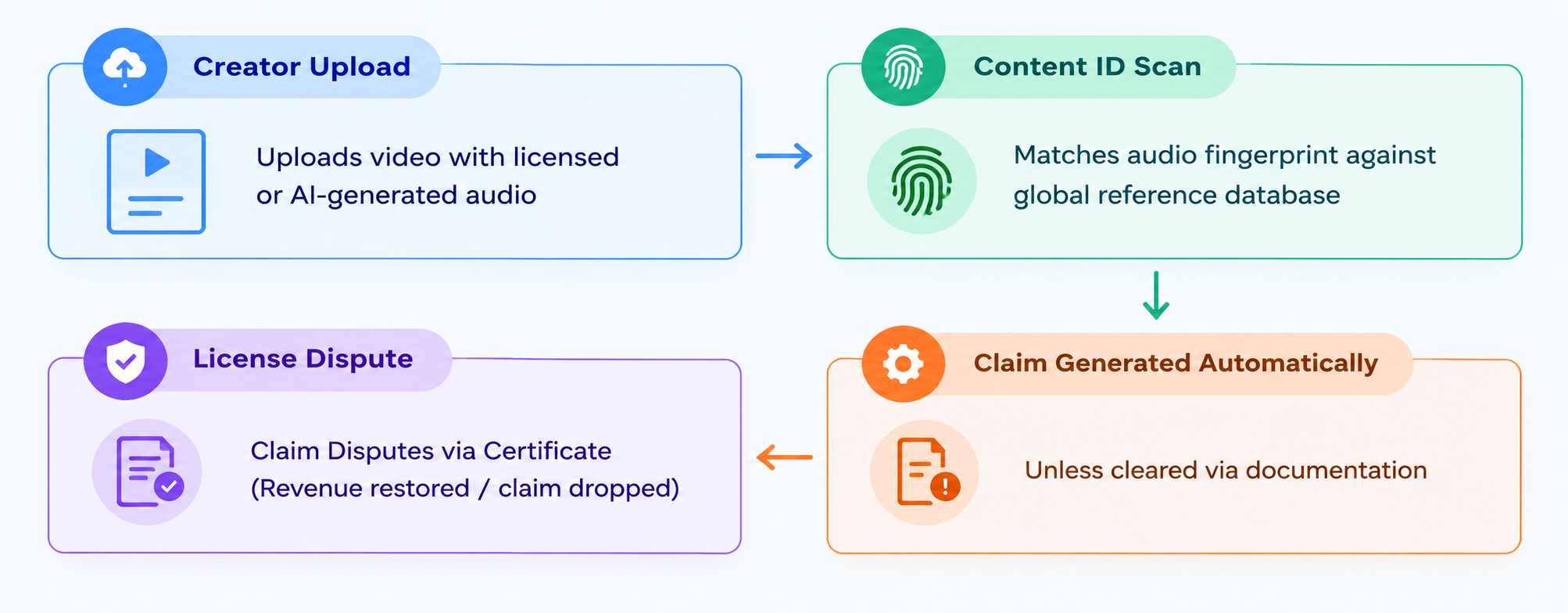
That can happen even if your use of the track is completely authorized.
“Royalty-free” does not mean “copyright-free”
This is one of the biggest misconceptions in content creation:
- Royalty-Free: Means that, under the applicable license, you don't have to pay ongoing performance royalties per stream or view. The copyright itself still exists and is held by an owner.
- Copyright-Free / No Copyright: Often used casually as marketing language. In reality, under global legal frameworks, purely machine-generated AI music lacks human authorship and therefore cannot be registered for traditional federal copyright ownership.
- Contractual Licensing: Even if pure AI audio isn't copyrighted, platforms grant usage rights via contractual licenses (EULAs). Understanding the terms of that license is what protects your channel.
Why YouTube Flags Cleared Audio
There are five common reasons automated systems flag audio:
- Rogue Content ID Submissions: Bad actors or misconfigured uploaders take non-exclusive royalty-free tracks or open AI audio and illegally submit them to music distributors while enabling Content ID. YouTube assumes the uploader owns it exclusively and flags every creator using the track.
- Missing System Integration: YouTube doesn't automatically receive a real-time copy of every license sold or generated across the web. The scanner only sees matching audio waveforms.
- Unnoticed License Restrictions: Some licenses permit personal YouTube use but restrict paid client work, commercial ads, or broadcast streams.
- Distributor Re-Registration: If a user generates or downloads a track and distributes it to Spotify via an open distributor, the distributor may automatically push the reference file into YouTube's scanner.
- Lack of License Documentation: If YouTube flags a video, you must be able to present machine-readable proof of clearance to have the claim released immediately.
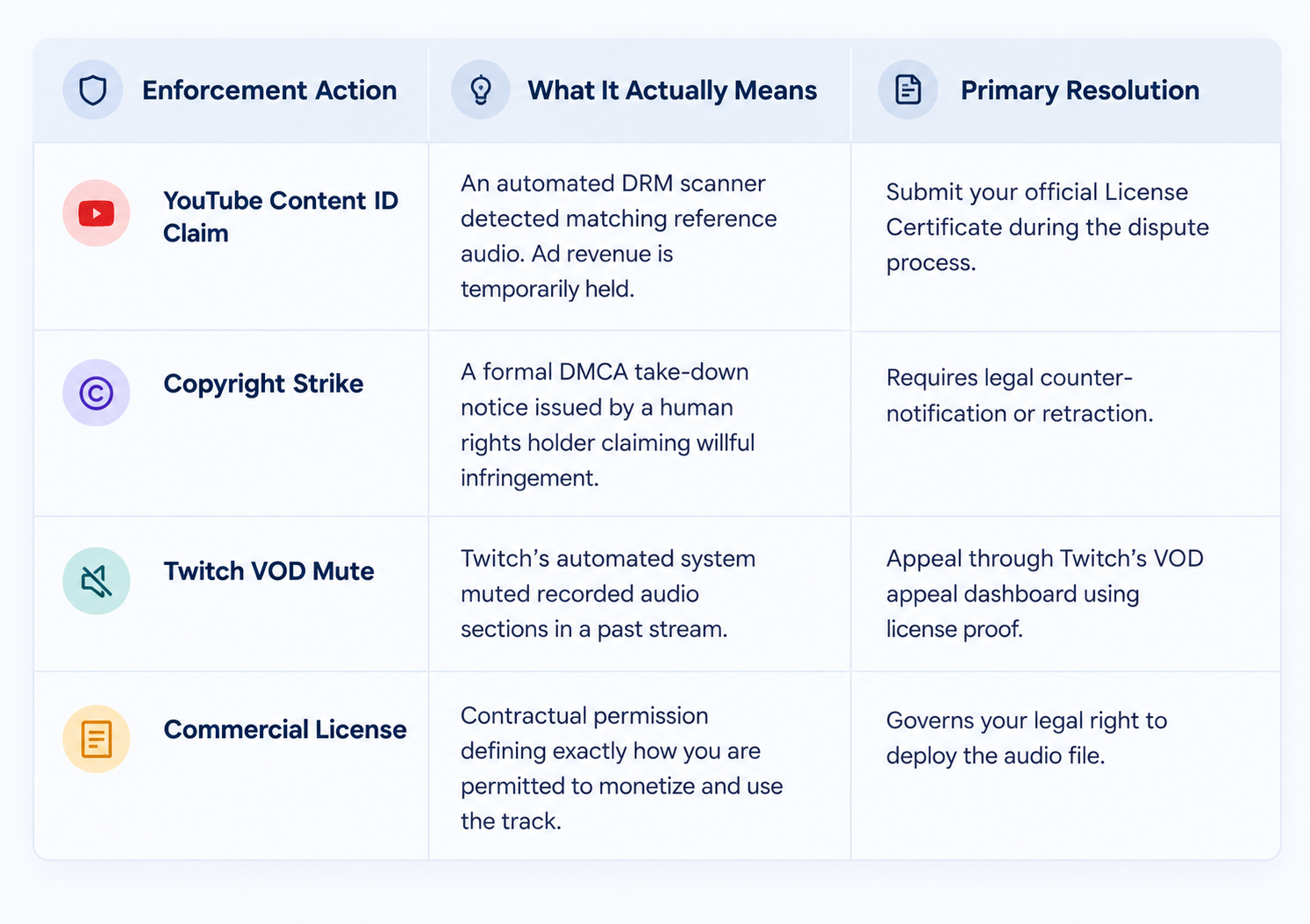
The Difference Between a Claim, a Strike, and a Mute
These terms get mixed together, but they represent very different enforcement levels:
There are several common reasons.
What if you could create the music yourself?
Instead of choosing a track from a large library and then wondering how it will interact with automated rights systems, you can generate original music specifically for your content. Melogen Studio lets you create music with AI text-to-music generation and provides royalty-free licensing for generated tracks.
Explore Melogen Studio →Does Giving Credit Prevent a Copyright Claim?
No. Giving credit is good practice and often required by attribution licenses, but automated scanners like Content ID cannot read text in your YouTube video description. An automated bot compares audio frequencies, not description text.
How Creators Can Avoid and Defeat Music Claims
The safest strategy is to stop treating marketing labels as a safety guarantee and establish a clear clearance process.
1. Store Machine-Readable Proof of Rights
Always download a formal license document alongside your audio. Platforms like Melogen Studio issue an automated License Certificate containing:
- Unique License & User IDs
- Target YouTube Channel Handle
- SHA-256 Cryptographic Audio Hash
- Generation Seed & Timestamp
If YouTube issues a claim, attaching this certificate to your dispute proves legitimate commercial clearance and drops the claim.
2. Be Skeptical of "No Copyright" YouTube Uploads
Random YouTube channels uploading "No Copyright Music" are a major legal trap. If the channel uploader didn't create the audio or doesn't provide a verifiable licensing portal, another user could claim that audio at any time.
3. Generate Clean, Original AI Audio
Instead of digging through libraries where tracks have passed through multiple hands, generating original tracks on demand gives you a much cleaner workflow.
Melogen Studio provides text-to-music AI generation alongside royalty-free commercial licensing. Because Melogen Studio commits to never registering its library into automated DRM fingerprinting systems, creators avoid accidental collisions—and if a rogue third party ever flags your video, your downloadable License Certificate gives you the exact paperwork needed to clear it instantly.
The Practical Way Forward
The goal isn't to chase vague "no copyright" labels. The goal is to use music where you can clearly establish who licensed the recording, what usage rights you have, and how to instantly resolve automated flags if they appear.
By understanding how Content ID operates and keeping machine-readable license documentation for every track you deploy, you can publish content confidently on YouTube and Twitch without losing ad revenue to automated claims.